
- The disappointment : A conversation with Scott broker -
By Milo Todd
Okay, so Scott Broker and I already knew each other from our time in the same Lambda Literary fiction cohort some years back. And okay, his debut was just published by my sibling publisher, Catapult. (My debut was through Counterpoint.) But neither of those was the reason why I not only bumped The Disappointment up on my list of books to read, but adored it.
My top interests in books are deep and complex portrays of loss, grief, and death. Such incidents are unavoidable in life, and yet everyone responds differently. In a world where so many of us increasingly look to numb ourselves and avoid bad feelings whenever we can, Scott embraces them head-on with a brilliant mix of tenderness, insightfulness, honesty, and humor.
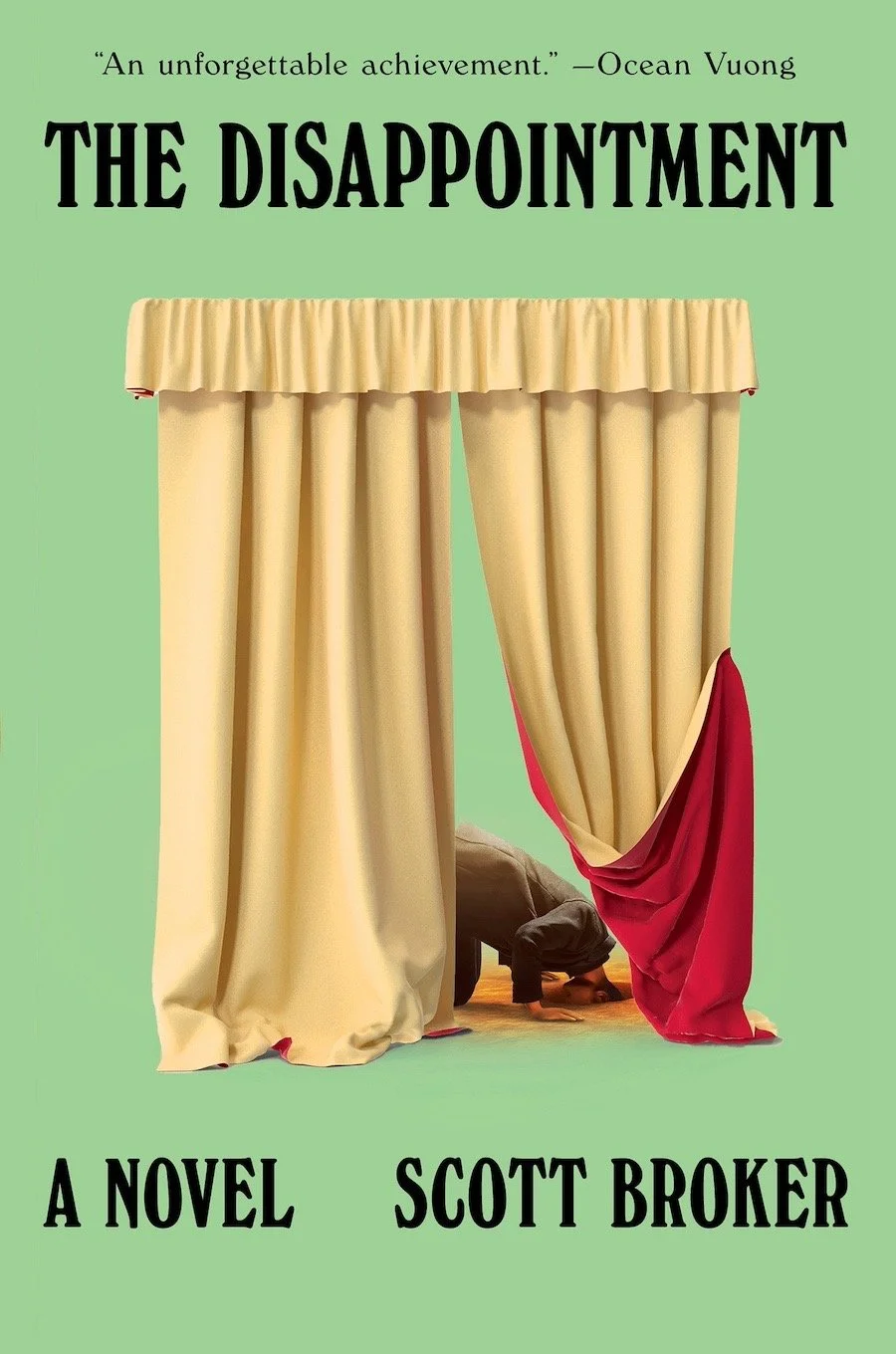
In his debut, The Disappointment, we follow Jack, who is mourning his recent decision to give up on his lifelong dream of being a playwright. It’s indeed a grief he must work through, a substantial loss to the life he’d spent so much time working toward. But while dealing with this grief, he’s also doing what he can to comfort his husband, Randy, who’s insisted on carrying his mother’s ashes everywhere since she passed away. When Jack and Randy travel to the Oregon coast for a vacation (yes, with some of Randy’s mother’s ashes in tow, as that ended up being the compromise), the couple run across various odd and unique locals, all of whom draw them further into the surreal while somehow never leaving reality.
In our world of fast-paced consumption and turning book reading into just another notch on our bedposts, Scott Broker’s debut resists all that. It instead requests focus, feeling, and mulling. You’re meant to take your time and connect with it on a deeper level. This is further helped with the beautiful prose, complex characters, and an expert balance of wit.
Scott was kind enough to do an interview with me about his book, which is out now wherever books are sold. Pick it up at your local bookstore or request it at your local library. It’s worth your attention.
Milo Todd: Thank you for giving some of your time, Scott! I loved this book. And since two of my favorite themes in stories are grief and loss, and I know you’re a feelings person, a lot of my questions are admittedly going to be about feelings.
So how did the idea for this book come about?
Scott Broker: I started this book in the aftermath of having failed to sell another one. For a few months, I was in a bit of a cave, existentially speaking; then, as it can sometimes go, I started to inspect the cave’s inner linings and realized that it was not all doom and darkness down there. Or maybe it was, but it was a doom and darkness I could be curious about. How do we metabolize our letdowns? How does our culture reinforce feelings of defeat? Is quitting something you love ever the right thing to do? My protagonist, Jack, was mined from these questions. I’m visualizing him now as mass of earth studded with jagged gemstones. I wanted to send him forth into the world to see if he, and ultimately I, could fare it.
MT: The sheer complexity of the emotions you take on here is impressive and rarely seen in literature. Were these complexities difficult for you to depict so accurately on the page?
SB: Thank you for saying this, and yes, very much so! A lot of my revision involved combing through scenes and making sure I was accounting for as many plausible shifts in emotion there might be. My first drafts often maintain one primary feeling in a given moment, when what I really want is to locate that feeling’s many tributaries, and to allow them onto the page, as well. I’m very invested in capturing the flux state of our interior lives. We sour, go sweet, hate our friends then beg them over for dinner. Capturing these leaps in an organic fashion was one primary struggle. Another was not being scared of pursuing Jack’s darker line of thinking. Will the reader think he’s a bad person? I’d wonder, then swiftly bulldoze past that worry. So what if they do? He’s made up. Also, thinking in terms of “good” and “bad” rarely gets you somewhere interesting.
MT: I mean this as a high compliment, but you show so much faith in your readers. You trust that they’ll slow down and pay attention to your novel in this hyper-consuming era of reading. That they’ll read your words as connection, rather than read as content. I feel a book like yours is infrequent these days, and I found it refreshing to come across. To have the opportunity to sit and marinate, most especially with feelings deemed “negative” or otherwise uncomfortable to many people. Instead of avoiding themes such as grief and loss, you embraced them to the point of beauty. Do you feel it’s important to slow down, to feel feelings, to pay attention to details and our surroundings? Whether that be books, people, relationships, whatever?
SB: I definitely do. I’m a big believer that anything can become interesting if it is considered closely enough. There’s a wonderful passage in Garth Greenwell’s Small Rain where the narrator expounds upon a potato chip with the same level of thoughtfulness with which he earlier expounds upon a poem. I left that book feeling as if the lens of my vision had been Windexed, making me want to grant items both large and small their due curiosity. We live in a world that is so frighteningly fast-paced that we’re at risk of missing everything along the way. So if our art can be one place to slow down, that’s a great thing. I am certainly more attentive to the world when I’m writing it than when I’m living it, but hopefully there’s some subconscious instruction happening that will lead one thing to eventually catch up with the other. I also find poetry and short stories to be instructive when it comes to putting faith in readers. They are less forgiving forms than novels tend to be, and I find the demands they make of their readers’ attention inspirational.
MT: What appears to be an overlap between grief and lust jumped out at me. Is that a correct interpretation? And, if so, could you speak on that overlap more? It’s something I never thought about before. The closest I can think of is that French saying about how an orgasm is a “little death.”
SB: Oh, I love this idea. I suppose grief and lust both involve reaching for an other, whether material or immaterial, in hopes of making contact. Both, too, are experiences that often exist without any actualization or contact. So often we lust from the confines of our bedrooms, alone. So often we ask for a sign from the dead and receive none. This isn’t to say that we never make contact when we lust or when we grieve. Of course we do. It is simply to say that there is rarely a guarantee that the hand we reach for (again, material or immaterial) will be there waiting for us every time we want it. Jack’s desire feels incredibly bound to his losses, and I suspect he’s always reaching for more things than one when in the throes of his lust.
MT: Could you also speak more about what appears to be an overlap between grief and self-indulgence? Where do you feel the line is for something like that? Do you feel there’s a limit, for lack of a better word, on human grieving, regardless of the type of loss?
SB: Our culture puts a lot of pressure to grieve in a standardized way. There are expectations on how we demonstrate our grief and for how long, and a literal list of steps all mourners are expected to pass through. But I wonder if some part of that comes from a fear that grief will otherwise get the upper hand on our lives. It’s easier to believe there’s an orderly program for how we mourn than to face what it is, in my opinion, our likelier circumstance, where everyone’s grief is entirely unique to them, and not going anywhere. Grief settles, of course, and might be less distracting once it lands in your feet than it was when it was sitting behind your eyes, but it is not expelled, nor should we want it to be. Our grief changes us irrevocably. I’m thinking of one of the central refrains from Lucy Ellmann’s Ducks, Newburyport, a very long novel written almost entirely as a list, where the following thought, or a version of it, recurs many, many times: “…the fact that Mommy’s illness wrecked my life, the fact that it broke me, the fact that I am broken.” Yes! I thought, reading this. Not because I wanted the character to suffer, but because it honored the ongoingness of grief. The character is changed by her mother’s death, just as Randy and Jack are changed by their losses. They will not be who they were, so give them some time (I say to my frustrated readers) to figure out who they are becoming.
MT: You’re also excellent at providing hints and nuance to specific dynamics for the reader to interpret and work through on their own. Almost like Rorschach tests of relationships between romantic partners, children and parents, etc. But with that said, I’m curious: How do you interpret the relationship between Randy and his mother? How do you interpret the relationship between Jack and Randy?
SB: I love this visual of Rorschach tests of different relationship types, and how they demand a certain collaborative component from the reader. We can’t know everything about anyone, including ourselves, and we certainly can’t know everything about the relationships that exist between others. It was important for me that so much of Randy’s grief is obscure to Jack: he hardly grasps the world Randy is in, and he hardly grasps the relationship dynamic that put him there. He sees Ms. Rourke as a pill and we, seeing her through his eyes, likely see her in a similar light. But Randy doesn’t see her that way, and the curtain between our understanding of her and him brings me great joy. It demands an admission of unknowing, an acceptance that this difficult person must also be lovable because here we have someone who so clearly loves her. I suppose it demands some faith in uncertainty. Her bond with Randy does seem forged, in part, by the trauma of having Randy’s father leave, but that’s just one part of the puzzle. We have far more parts of the puzzle for Jack and Randy’s relationship, and even still we are left without a total portrait. A lot of readers seem to think they would do things differently if they were Jack. I’m more curious in observing Jack as he is, and letting his more inscrutable actions guide us toward a fuller understanding, one built by inference and gesture.
MT: What was your process like? To capture all these complex feelings in such nuanced ways, was your process more stream of consciousness or was it more meticulously planned?
SB: Outlines and meticulousness in general are not for me, alas. When I started the novel, I knew the central dynamic between Jack and Randy, the first scene, and maybe four or five events I thought might occur on their trip to Oregon. From there, I let myself roam freely toward those events, some of which never even occurred. The hope in writing like this is that story begets story (or, more granularly, sentences beget sentences), rather than some external structure that predates the formation of the text itself. This feels more organic to me, and I like the idea that the reader is experiencing the organic movement of my imagination as they read. There’s also a much higher chance for me to be surprised when I write in the partial darkness, and I tend to feel that if something is surprising for the writer, it will inevitably be surprising to the reader.
MT: What was your favorite part to write?
SB: Big picture: the chapter titles and the dialogue. The chapter titles felt like neat little distillations of whatever followed. And I could write dialogue forever. I love the way people express themselves, verbally, from their corners of the universe. More specifically: I had so much fun with the sequence of scenes at Polly and Paul’s (Jack and Randy’s vacation neighbors) house. Those two had such an unpredictable energy from the moment they emerged naked from their hot tub, and I was able to lean into that unpredictability in a way that was very gratifying. To my earlier comment about surprising oneself while writing, this sequence certainly caught me off guard in where it goes. I’ve had several readers say they want to party with Polly and Paul, and I’d have to agree.
MT: Since we’re nearing the end of the questions, hopefully this is a more fun one. You know how high school yearbooks have those superlatives like “Most Likely to Succeed” and “Best Hair” and stuff? If you could write superlatives for Jack and Randy (and any other characters, if you’re feeling it), what would they be?
SB: Oh wow, I haven’t thought about superlatives like these in so long. I’m glad to have achieved one of mine (“Most Likely to Write a Book”) and to have dodged another (“Most Likely to Come Back and Teach at This School”).
Jack — Most Likely to Wear a Fake Cast
Randy — Most Likely to Bring His Mom to Prom
MT: I know your book recently came out, but do you have plans for another in the future?
SB: I’m actually pretty deep into a new novel. I’ve yet to lock down my elevator pitch, but it involves deserts, desertions, and a door in the basement of a suburban home that opens to oblivion. I’m sad to report that it isn’t half as horny as The Disappointment, but who knows what’s ahead.
MT: Thank you so much for your time, Scott! This interview and your book are true blessings.
SB: Thank you so, so much for these wonderful questions, which I had such a fun time answering. I’m very grateful to have the book read so thoughtfully by you.
The Disappointment is out now wherever books are sold!
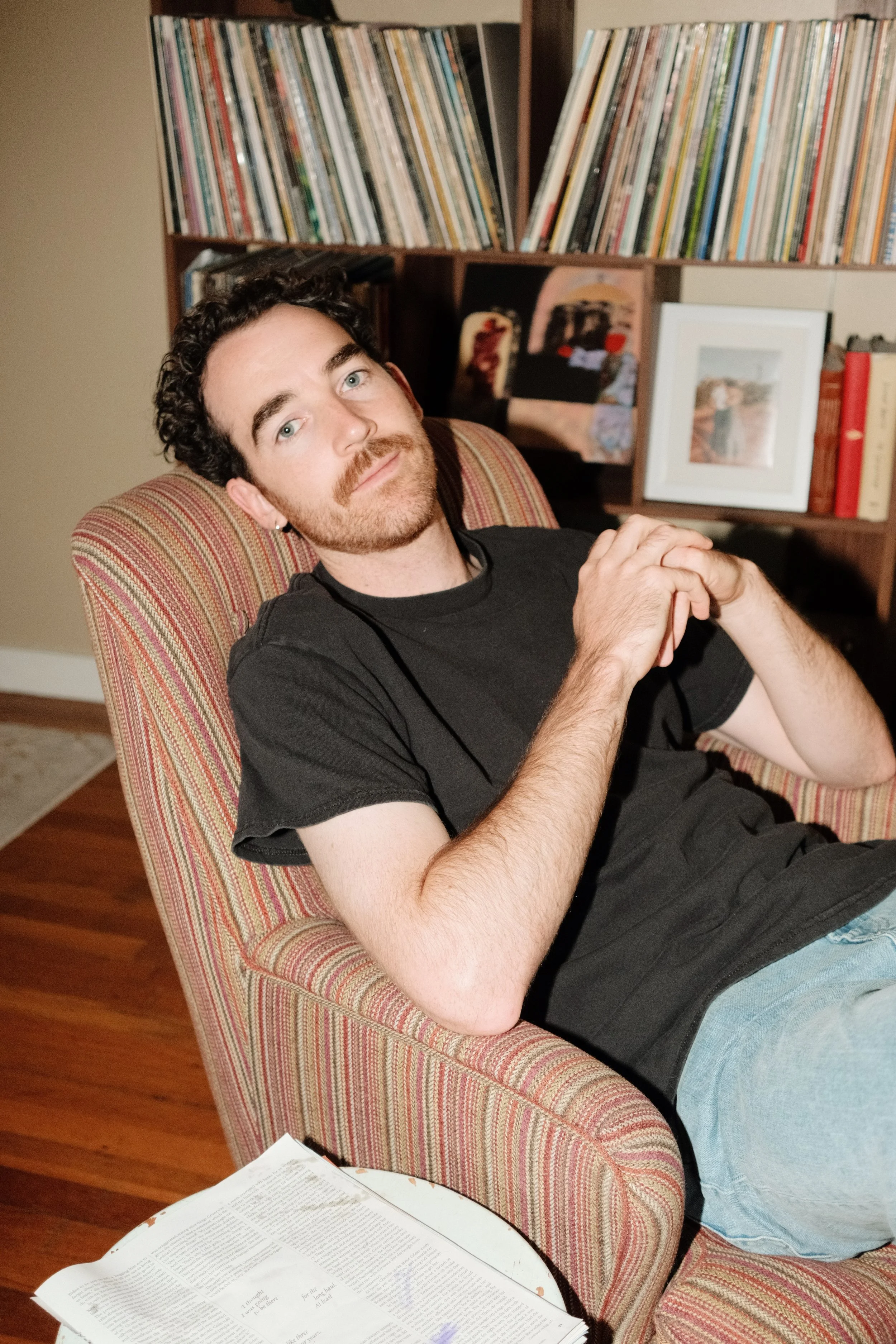
Scott Broker is a queer writer, teacher, and bookseller based in Los Angeles. His debut novel, The Disappointment, was named a best book of the month by Bustle and Kirkus Reviews, and a most anticipated book by the Los Angeles Times, LGBTQ Reads, and The Orange County Register. His other writing appears in New England Review, Guernica, Fence, and the Idaho Review, among other publications, and has been awarded fellowships from Tin House and Lambda Literary.
Milo Todd is a bestselling author and an amateur stop-motion animator. He’s co-EIC for Foglifter Journal and runs The Queer Writer newsletter. His debut novel, The Lilac People, is a national bestseller, a Lambda Literary Award Finalist, an ALA Stonewall Honor Book, runner-up for the James Patterson and Bookshop.org Prize, a Goodreads Choice Award Finalist, a New England Book Award Finalist, a Libro.fm Bookseller Choice Award Winner, and more.