
Erin Noehre is a poet and educator. She holds an MFA from Arizona State University where she was a 2020-2021 June Jordan Teaching Fellow. Her poems have appeared or are forthcoming in Indiana Review, Academy of American Poets, Apogee, Foglifter, the anthology, Another Last Call: Poems on Addiction and Deliverance, and elsewhere. She is currently a student in the Creative Writing Ph.D. program at the University of Cincinnati.
Dani Janae is a poet and journalist from Pittsburgh, Pennsylvania. Her work has been published by Longleaf Review, SWWIM, Palette Poetry, South Florida Poetry Journal, and others. Hound Triptych (Sundress Publications) is her first collection of poetry. She lives in South Carolina.
- Gossamer Hauntings in Dani Janae’s Hound Triptych -
By Erin Noehre
“Like most people, I have wanted love all
my life. Pursued it like a hound. Gave my
body, abandoned my soul in pursuit of love.
And so I have betrayed my tenderness—”
from Hound Triptych Adoptee Log #7
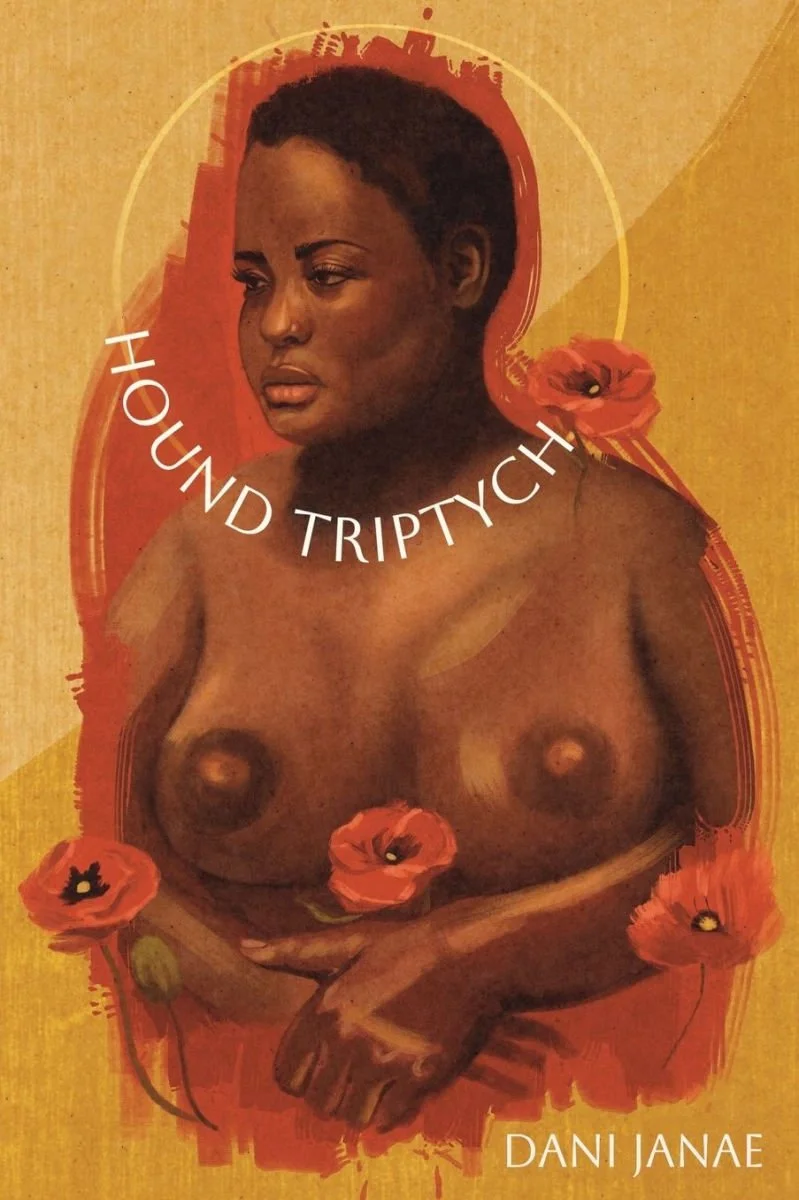
In Dani Janae’s debut poetry collection, an honest and spirit-cleansing lyric traverses the difficult ground of the Black transracial adoptee experience, giving language to a narrative gap in Black lineages of suffering and survival, in all its difficult beauty. I hear the poems in an aching and devotional lilt as the speaker carries devotion to their grief, to their story, and to the Mother from whom desire itself is made and through whose absence the speaker experiences a repetitive cleaving from and cleaving to harm. As Janae traces both the absence of the Mother figure and an undeniable connection to her from pre-birth to babyhood, childhood to adolescence, and throughout addiction and sobriety in adulthood, Janae reveals throughout the text that the self is as precarious a ground to tread as it is necessary.
The legacy of Janae’s poetic inspirations, such as Toi Derricotte, shines through this work effortlessly. Like Derricotte, Janae maps the miraculous becoming when one suffers abuse and comes to stand in their truth, not from a position of a victim, but as a survivor. In “Adoptee Log #3,” the speaker unpacks the stories their adoptive mother told them of how lucky they were to be “rescued” by her: “I watch her stalk the aisles of the pound, /dragging her fingers along the bars, pointing, / saying "that one" as she met my sad brown eyes.” But, later in the poem, the speaker finds a path to autonomy and choice in unlearning the adopted mother’s story of them: “To unlearn the narrative of the dog, / I stood up from all fours. I came to know / my mouth, the curve of my wicked spine / I stopped howling at any sound at the door.” This is a miraculous becoming, a miracle transformation, a gift, because, simply, as Hound Triptych shows, survival is not an inevitable conclusion. Often, the long-standing damage of brutality inflicted on a child by a caretaker, particularly racially violent psychological damage, can prove insurmountable.
When a caretaker hammers over and over again a narrative of “wantedness,” “saviorism,” and white superiority, a child’s relationship to themselves can lead them down a precarious path of self-harm, as they learn to mirror the hands that first hurt them. Janae does not shy away from these instances of self-harm and addiction, but through fearless examination reveals how those impulses contour the double-blade of desire. In the opening lines of the poem “Please Tell Me a Story of Mothers and Mothers and Mothers,” Janae writes: “What can be done with my / immortal need?” In other poems, desire’s double blade in the form of alcohol and drug addiction is handled with both frankness and astute image work: “I drink sparkling water because / I want to drink alcohol. I want to drink alcohol because / it turns the haunt gossamer.”
Gossamer haunts, immortal needs, arrive most strongly for me in the poems that ponder pre-birth and the longevity of desire for the Mother figure as a kind of immortal faith. In “Birth Mother,” time and the womb are configured circularly, moved by waves of desire and absence. In many ways, the womb is the only prior location to trauma and abuse in the world of an adoptee. It is as much a site of continual genesis as it is a site of continual loss: “All things lost to the womb, I left / my name curled like a twin inside / of her.” Loss, in these lines, becomes amniotic, flowing through the most complete bodily connection that two people can have: the connection between a birthing-parent and child.
The feeling of immortal need coalesces in one of my favorite lines of the text: “I want to be adored for every lost day of my life.” As June Jordan tells of a silence particular to the female, we can also see that there is a silence particular to the Black female, the Black queer person, the Black transracial adoptee. Such specific griefs of origins and formations can feel so particular to each of us, it seems almost impossible to come across another person who knows just how it feels to carry our hollow. But, lucky for us, poetry can be a place where that ritual of seeking companionship takes flight. A place where we can find another who speaks with audacity and honesty to name the hurts we didn’t know could be named. For myself, as a fellow sober Black queer transracial adoptee, I couldn’t be more grateful for this work of unflinchingly honest self-examination and critique on the racist legacies of transracial adoption and removal of Black children from their parents in this nation. Not only does this text fill a necessary gap in the archive of these colonial legacies, but Hound Triptych also provides crucial companionship on that difficult road from victim to survivor. The message of this book is that there is, in fact, something after a disaster, and that something, though it may be soft, is not without its own challenges. As is explored in poems that ponder the strange new life of sobriety: “I make amends first to my mouth, then to / the rest of me, parts gone soft, overripe.” Janae shows through this powerful book that if we fight to have contact with the wound, with our overripeness, rather than avoid it, we may too arrive at an unlimited potentiality: “I fought to open myself / to grace, and grace, many legged, shone through me.”
This book will be turning my gears for a while to come. Thank you, Dani, for living it and seeing it through, for all of us.