
- Drinking This Sweet Intoxicating Elixir; The Many Secret Joys of Aaron Shurin's Poetic Legacy -
By Anthony Zedan
Aaron Shurin the alchemical poet who found his place and voice in mystical San Francisco has discovered the Elixir of life—it is found in an amalgamation of imagist poetry mixed with philosophical wanderings inspired by the wonders of male lovers and being out in nature, always true to his inner nature, the outer and inner natural worlds commingle so agreeable in his perfectly-tailored poems that span more than five glorious decades. Some of his haunting poems read like stark modernist or cubistic paintings, full of fractured places and things, seen from interesting new angles, especially the special people the poet has surrounded himself with over the years. Poems that read of loving and meaningful encounters at a time when the mere act of loving could get you killed. He and his poems both have an elegance and classiness about them—a beautiful, perfectly-selected worldscape of recollections that remind us of all that is eternal and how our bodily senses can, when listened to properly, get us to that place where pleasure and beauty intersect.
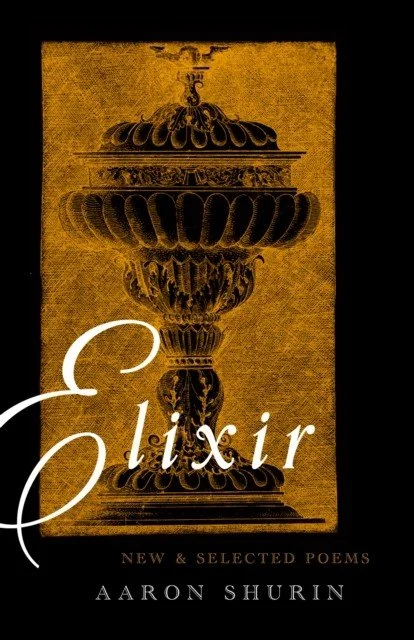
His short gray locks mock the city skyline of hills that receive nightly visitations of cool and refreshing fog. His poetry is both cool and refreshing, alive and vibrant; even his earliest work is just as important today as it was at the height of the Gay Liberation Movement, and maybe, even more so. The covered goblet on the dignified book cover might as well be a stand-in for the poet himself; beautiful and ornate on the outside with the mystery of the elixir of life inside, right at our fingertips, the poet wants us to "swallow the sky" like he does and understand the nothing that exists inside—only love, art and nature really matter. He wants to initiate us all into this mystery.
His poetics is one of rhetorical questions and nature metaphors pointing to what lies below the surface of people, their inner weather, moods as landscape, from something that is as impossible and possible at the same time as, "a blue cloud of his mind." (pg. 5). How can a cloud literally be blue unless it is a metaphor for some inner state of mind? Clouds can give some people the blues. He ponders whether poetics is as simple as cataloguing sights and sensations and attributing ownership to those things or traits. In the end, poetry has to be rooted in someone or something real. His poems read like Socratic dialogues between the body and the soul. His poems are liberating in the sincerest form imaginable. His poems cause us to question the very nature of meaning; we are reminded of the fact that any one poem is always greater than the sum of its parts. And among those, what is a man and his relationship to the universe? what is a me and what is a you? And who are all of these actors engaged in action? And are we not all really connected in a deep and meaningful way if we pull away at the surface of things?
It is the solemn obligation of all poets to commemorate every epiphany they encounter and so they can often lead exhausting lives of intense observation and reflection followed by necessary quiet down-times to re-charge their metaphoric batteries. Mr. Shurin reminds us of the beautiful myths we can create with others, stories that shine with the truth of goodness and eternal expanses—forever looking outward that brings us back inward toward an inner truth.
He writes with poetic freedom, learned and absorbed from the modern tradition of Walt Whitman, but can go one step further in his eroticism, pushing the limits of how we describe our own desires, sometimes simple and sometimes complicated. His early poems helped liberate the gay lexicon from its place of subculture into mainstream culture. Gay poets, we never wanted to be equal with straight desire—we aspire to exceed it and celebrate our uniqueness.
In the thirteen poems that make up the new poems in his latest book, which we could whimsically interpret as Aaron's take on "13 Ways of looking at a Blackbird", Aaron's brilliance shines through best in his almost post-apocalyptic sci-fi-ish poem "Dome" which, arguably, can be seen as a summation of his life's work starting from the "Night Sky" forward. What was once rhetorically lighter fare becomes surprisingly dark and moody, more contemplative of what it all means to be a poet struggling with his own existence in the 21st century. San Francisco was once a magical City of Domes back in 1915 for the Panama Pacific International Exposition. But the dome of San Francisco City Hall comes to mind at first, where poems reverberate off its walls at least once a year. But his dome is the "dome of space" as depicted in alchemical and medieval illustrations, drawing and hand-painted maps of the limits of the known universe. The speaker of the poem contemplates the possibility of "other dimensions in the dome of space" (8) which may manifest themselves as " a city spectral... a city unknown."(8) The curvature of the dome which may be the cobalt sky as mirrored into the convex lenses of a human eye seeing itself for the first time. The complexity of consciousness allows us to see ourselves reflected out in the beautiful and terrifying vastness of nature and wonder out aloud if we ourselves are, in the end, a nothing or a something. The dome of space apparently offers no protection against "alien spores" that steal the color from the eyes of a person in a hospital bed; the other and the self ever inter-colliding into one shared identity. The "night sky" of this world takes a dark turn, "translucent / for dark things." (8) The speaker could be referencing a night in a hospital bed hooked up to machines as well as an "electric night" in which he and the other were "socket and plug" (8) and may have led him to the startling revelation, "Is that thing / the sky now: blue venom?" (8) It is unclear at this point whether the "you" is another person or the speaker addressing himself, when he observes, "You made what you needed to see and yes my body / is falling away" (9) but he does conclude that, "...your unfinished quest- I / was here, I am here- hovers like a charm of hummingbirds: the living apparatus of suspended animation." (9) and that the nothing that is when he closes his eyes makes his bodily feeling and expressions even that more important.
The poet needs the freedom that space (a thing made of nothing) provides with vast kind of quantum imagination with which to catalogue the many layers of feelings, sensations and expressions that come and go into our field of vision, ie. dome. I think the "dome of space" in Aaron's poem has more to do with a spiritual destination than an earthly one, not that much different than the dome in W.B Yeat's "Sailing to Byzantium"—a place "out of nature" where our spiritual selves would, given the choice, prefer to "gather... into the artifice of eternity." Aaron takes us on a journey through a post-apocalyptic Byzantium of sorts in which he must make sense of this distance charted between "the city of breath" i.e. the living, and "the city of dust" i.e. the dead. The speaker is navigating this space between the physical and the metaphysical: we are asked to consider these in-between places : "What of other dimensions in the dome of space?" (8) Our attention is drawn upwards and outwards and inwards. Life as seen from the perspective of a hospital bed in the back of a makeshift ambulance is much different from when he "once" had health, youth and beauty, "Once I stood upright / and scanned the horizon for meat" (8) and "once we stayed in bed forever/ in the electric night..." (8) and the speaker of the poem tells us that he is going to try his hand "at making a world." (8) How unrecognizable the sky at night has become, and the speaker wonders if the poisonous "blue venom" of choking air "render[s] our chests useless, heaving sea swells in a teacup, stinging like smoke?" (8) I am reminded of Auden's lines in his poem, "As I Walked Out On Evening", "The glacier knocks at the cupboard, / The desert sighs in the bed, / And the crack in the tea-cup opens / A lane to the Land of the dead." The speaker of "Dome", reflecting on his world-building imagination, reaches the conclusion, "You made what you needed to see and yes my body / is falling away, I'm just a passenger now, not detached but watching: the unspooling..." (9) We are spun into existence like delicate thread, spooled, unspooled and then cut by the Fates: and so we all find ourselves in this middle earth of bodily knowledge and wisdom. We end up with an omniscient eye like in the eyeglasses billboard sign in the Great Gatsby that must play witness to this drama as it plays out to its beautiful and tragic end. The speaker goes out of his way to say that he is "not detached" because the poet understands that he can still make a difference in the world. We need to be reminded from time to time that all of us as poets and readers of poetry can make and become a positive difference in and to this world.
The first poem of the new section, "The Story I Tell," which is ironically less narrative than lyrical (as a friend of mine astutely observed), makes you instantly wonder about the other person. The title itself can be read ironically in the sense that the other person may most likely give you a different story, but my side or version of the story is this. A love affair that lasted months and was a story onto itself, which is the conclusion of the poem that is made up of strong images that takes us through the gates to the porch where a first kiss unravels a name in the mind of the speaker—a name we will never get to know because even poets need their privacy. The speaker, with poetic panache, says he, "struggles to struggle with honor and truth" (3) meaning that for him, it was never really a struggle, even though these are qualities that some people in general, and the lover specifically, often struggles with, so we are to conclude that this poem and the proceeding ones will be shining examples of both honor and truth, but whose truth? Whose honor? I feel like the picture presented is a gay Romeo and Juliet set scene, objects in all the right order, adjustments made here and there, memory and the imagination are like the twin stage managers getting everything ready. Then comes "the hair" which passes from lips to lips to tongue in a very John Donne way of connecting these two lovers. Does it really matter whose hair it was originally? When it comes to lovemaking, all things are a shared pleasure. It is so easy to get lost in the other, to become a story of months of sleeping together. In the end, a close reading of this poem may make you wonder if there really was a real other in this "story", and if so, how real was this other? Here we see that the art of the poet as storyteller is telling a slightly better version of the events. A love affair that lasts three months can be interpreted as happy or sad but most likely bittersweet: the pessimist might say only three short months; the optimist would say three long and memorable months. The poem itself is an act of remembering with honor and truth to the feelings felt, to the coordinates of the locus of a sensation and a feeling, or a visual map to the heart of what is true.
In "Memorial Day", the speaker is memorializing another one of his lovers, and in the act of remembering the other, remembers himself—who he is. We are presented with the image of the tree which can only "paraphrase" the sky which in turn is "arbiter of wind and sun." (40) The "you" of this poem, like St. Francis, gives "an impassioned speech to the pigeons" is just as ephemeral as the "you" of the first poem, a "you" that could believable pass as an "I'. The "hiss of air" is not coming from the speech but rather from the sound of the pigeons' feathers that make a sound approaching "kiss me" or "kill me." The words themselves are being delivered through the natural world, contradictory messages that could make or break a relationship. The poem tricks us into believing in the other that is just as easily "erased" by the end of the poem.
In "A Final Address to the Jury", a poignant poem which sounds like a final farewell, Aaron eschews both judgment and appreciation, knowing his "galactic" origin story, "...born among stars...", which transcends genders and other preconceptions, he explains the he would prefer, like Whitman in Song of Myself, to "...depart like the air." (11). All great poets have this air of being, in some sense, "untranslatable." The poem makes us wonder why he would portray himself as on trial. What crime could he possibly be accused of? But as all gay poets since time immemorial, we are all being constantly judged and persecuted by a savage and vengeful society at large. He craves abstractions and fog-like "miasmas" to the clear-cut realities that surround him and limit definitions. He celebrates the death of the ego and of his earthly form, "It's been lovely / since I dropped my face and form. I'm pure feeling, in relation to nothing." (11) What a transformation! And when we read his poems out loud, we will be breathing him deep into our lungs and feel something real and meaningful. Ultimately, we will all have to throw off the many layers of "meaning" to reach any epiphany or feeling or truth and merge with "the nothing that is and the nothing that is not." We are encouraged in the same way Auden speaks of Yeat's passing: "Follow, poet, follow right / To the bottom of the night, / With your unconstraining voice / Still persuade us to rejoice."
I have unanswered questions about the poem, "The Naturalist." Is the very first rhetorical question referring to when we first wake up and open our eyes in the morning or when we are first born and open our eyes for the first time? Or both? Either way, when we first open our eyes, we find ourselves in that in-between world; no longer in that flowing river of dreams and distorted memories and not yet fully arrived to the certainty of that day's weather. The first thing the naturalist hears is "the toot of the tugboat, a little pig in the water.”(7) Which is natural considering he is close to the water, a window must be partly open behind “the billowing curtain" that delivers a breeze, "the sun's breath" (7) that has turned said curtain from "blue to lavender." (7) There is a beauty and truth to describing the breeze as "the sun's breath" in that it brings to mind the poetry of John Donne where he lingers with his lovers in bed in the morning fighting off his "unruly sun" but, in addition, scientifically, the wind is a product of the interaction between high and low pressure zones which are affected by the power and presence of the sun.
We know the sun by its effect on other things, in this case the change of color of the curtain from blue, actual and figurative, to lavender, loud and proud. I am going to make an educated guess that this image is actually colored in with a childhood memory of two specific children's picture books, Little Toot and Scuffy the Tugboat: tugboat stories about the romance of journeys to far-off places and growing up in the process. These little tugboats are witness to strange cargoes from distant lands. In Little Toot, the little tugboat loves to play all day making figure 8's in the river, until one day, the other tugboats see what had happened so they begin calling him a sissy who only knows how to play. Little Toot spends the rest of the book proving he isn't a silly and frivolous tugboat by rescuing an endangered ship that larger tugboats could not get to. In Scuffy the Tugboat, the little toy tugboat comes to the realization that he was "meant for bigger things!" Are these childhood memories that happy place we often find ourselves going to in times of distress? The naturalist commands us, "If you have a place / to go to go now." (7) Like the fog that we see in the second half of the poem, these images will obfuscate as much as they elucidate as they are both intensely personal and anecdotal while breaching on being universal. There is a definite shift in tone from dreamy and peaceful to the barbarity of possibly the morning news. We are presented with "slaughter in the plaza" which sounds like a headline ripped from a newspaper about an atrocity or mass murder. Violence in the city center is a universally-understood reality of modern life but could also be a metaphor for "killing the thing we love." But the word" slaughter" can be both a negative word and a positive slang expression. As a positive term, slaughter can mean to perform or accomplish something in an outstanding and conspicuous manner or to dress well with an incredible sense of style. It could be a positive memory of a European vacation to a famous plaza where a wishing fountain exists not unlike Trevi fountain, a place where lovers go to make a wish, often summarized as a wish that love will bring them back to this place. As the coin is flying through the air, the naturalist wonders, " What is a coin really made of? / Coiled energy? Suspended sweat?" (7) Is taking the trip itself or the memory of the trip an "act of redemption?" (7) At this point, we are commanded to come back: "If you have a place to come from come now." (7) The childhood belief that by making a wish with a coin and tossing that coin in a water fountain will make that wish come true is beautifully rendered in the line, "We think of a / thing that we want and it becomes a golden pellet," (7) which helps explain the alchemical process of the imagination to turn wishes into realities. Aaron's genius is in his way of taking an overused trope and re-imagining it, whether it is a fountain of youth or a flowing fountain as a phallic symbol, by the power of making the familiar unfamiliar, by conveying the esoteric riddle of existence and unfolding nature of consciousness, and by meeting the world from a place of love.
I am reminded of the lines from Jim Daniels' poem, "Jet of Water", I am in love / with any fountain / I am promiscuous / with fountains / I have made my wish / I have tossed my coin... oh Lord when I die / (when I die) / leave the water running." (80, Blue Jesus) In the next section of the poem, the naturalist observes nature and its effect on him, "I watch the / afternoon fog overtake the hills... the morning fog vanishes from within... an exhale." (7) As he exhales, he ponders whether the sky and clouds are also "actually breathing in and out?" (7) This is an important point in the poem where we come to understand that only a naturalist would, not just anthropomorphize nature, but see himself reflected in and disappearing in nature. The dangerous power of natural disasters, as you might see on the news, becomes nature's anatomy, anatomical functions and act of existence,"The lungs of the spewing volcano. / the suction of the spinning tornado, the roiling typhoon inhaling / the coconut palms." (7) which in turn, reflect back to the naturalist's body itself which may also be experiencing these acts of natural catastrophic disaster.
You could argue that Aaron is doing a disappearing act of sorts in his new poems. The more the speaker tries to convey that he is there, the more the reader realizes he is not. The speaker in his poems is constantly in the act of transforming into something else. If I had to assign a field of color to his poetry, it would be pastels because there is a beautiful softness and blurriness to his poetry. Like all great poets, he would rather leave you with unanswerable questions that will linger for a lifetime.
In "The Fable of Earthly Origin", we are at the onset presented with a contradictory understanding of the word "fable": will the speaker tell us a Genesis-like "story" of how we began on earth? Or reveal the "lie" told to us of our earthly origin and to what extent are we out of this world? Are we less body and more spirit? More star flame and powder? What is the point of all this beauty and beautiful longing? The speaker of these poems seems to glide with ease in and out of his real, remembered and imaginary realms, so it is no stretch of the imagination that the speaker wants us to hold two contradictory ideas in our mind at once. The earth is constant in a way we cannot be. We are made up of many small mysteries: a sky full of stars, the brilliance of stars themselves, the air gives us life and makes all life possible, the divine and terrifying vastness of space, the procession of ages and the grace of motion and change. The speaker of these poems confesses to being carried forward by "the rush of this stream" (13) which is the stream of consciousness driven by the basic building blocks of thought, how things and actions interact symbolically, mirroring one another. You could argue that the "you" of this poem becomes the "I" which then becomes the "you" which is the I" in the form of the "we": all familiar terms struggling to capture the meaning of a feeling—the feeling of love that manifests itself as the vast and all-encompassing feeling of being connected to everyone and everything but especially to your own body and your lover's. What a wonderful way to begin, with the flowering of the mind, then the igniting of the eyes, the heavy air between them and the realization that it is "Too hot to fuck." (13), making our way from romance to reality that lands like a punchline—sometimes the universe has a sense of humor. The speaker describes himself as being,"naked beyond reckoning" (13), further emphasizing the effect of the extreme heat upon the mind as well as the level of intimacy and vulnerability that our own nudity in the presence of the other both empowers and disables us, as well as humbles and mystifies us. At this point, we are dealing with two kinds of heat, one literal and one figurative. Intense heat is needed to turn butter, sugar, and heavy cream into caramel, and where does the salt for the caramel come from, his lover's sweat, or so he imagines. We must assume that his lover is caramel-colored, and a sweet creamy treat, a sweet and salty indulgence. The caramel-making and love-making processes go too far, get too hot, and, further on in the poem, result in "burnt sugar." (13) We should think about the difference between fucking and making love and how that shift is possibly something the poet is aiming to depict. When we make love, we touch upon what is both divine and universal in all of us. I can appreciate how the speaker comprehends the grand scope and breadth of all human knowledge, from philosophy to mathematics, through his lover's literal and figurative body, the way the other's body both centers him, anchors him while also allowing for a point of departure for the imagination. The speaker declares, "...we are the / flag of my disposition, unfurled in morning light." (13) This phrase is borrowed from Walt Whitman and his poem “Leaves of Grass” to express how the speaker in Aaron's poem is proudly displaying his inner joy of being connected to his other half while also expressing how he is the descendant of a long literary tradition—grass unfurls, a flag unfurls, a relationship unfurls emotionally, a person unfurls to to his fullest potential, love itself unfurls. The proximity of "birthday suit" and "unfurling in the morning light" brings the logical mind naturally to the morning erections that men tend to wake up to, in the same way a flag necessitates a flag pole and a strong wind. I do admire the desire to proudly display the interwoven flag of love and lust the speaker has for his lover.
If this poem is a fable of sorts in the traditional sense, the reader would not be wrong to expect a moral by the end; which begs the question, what is the moral of "The Fable of Earthly Origin"? What is the "press for a beginning"? (13) Is it the "pressure" we feel to have to explain how existence itself began? To feel compelled to explain our most basic instincts? The pressure we may feel, from time to time, to attempt a coherent explanation of the inexplicable? So the speaker attempts to explain with a stream of consciousness a story of moods, tones, fragments of memories and feelings and sparse but effective images of where we all come from. Possibly with a cosmic "rhythm dance"? It literally begins with a "flowering brain" as the first two words attest to, but whose brain? God's brain? The poet's brain? The speaker's brain? The "we" brain of the two lovers who come together to re-create the moment the universe first began? A common theme among this and other poems, I would argue, is that less importance is being put on the "I" of these poems as it is seeking out its other half, like the story of earthly origin from Plato's Symposium on Love. It is a beautiful journey of finding your other half and re-connecting to an original state of divine grace. (There could also be an inside joke in the phrase "press for a beginning" (13) in that it could be a reference to the invention of the printing press and the need to anchor down a feeling or a flavor into a book which is a kind of forever). So if we revisit the final lines, "...his mind, my mind, your indefatigable wish to walk as we do / under spell of the forward leaning arch, the press for a beginning, / again, beginning again." (13) We, the readers, wish to walk like lovers do, under the "spell" that a "we" are moving forward, the illusion and romance of forward motion and the assumption of progress, the pressure to begin again and again, creating and cherishing new memories and sensations along the way, this "heap of images", like the "translucent crawfish" caught in the "rush" of the stream. What is this "rush" referring to? The mad and feverish rush of crawfish to mate? The rush of the stream that is carrying them forward toward their destiny? Or the rush of chemicals that floods the mind or the rush of feelings that flood the heart when in the presence of the other/lover? We are accosted by a rush of images, feelings, sensations and astounding transformations. The crayfish with their translucent animal bodies not that much different from the human body "naked beyond reckoning." (13) This translucence may be a celebration of the mind's ability to "see" into the inner nature of the self and others. The poem ends in a figurative threesome by reaching out toward the reader by acknowledging the longing we all feel in the presence of true lovers. We all hope to experience the thrill and rush of starting again, starting over, starting anew, again and again, the sweet stickiness of new beginnings, until the end of time.
I may be wrong, but something about the final lines of this poem seems to imitate a return to man's first attempt to walk, and the forward motion, the arch of the back and the arches of buildings designed to lean forward, support a weight and take us somewhere new and exciting, a new way of knowing. We are definitely "under [a] spell" by the end of the poem by design. Like the cooking metaphor of making caramel, the end product looks nothing like the starting ingredients—and what a delight to enjoy the end product of a skilled chef! We are tempted by the aromas into the kitchen and bedroom of this poem and find ourselves asking, "what's cooking?"
No one can deny the universal joy in lying on the grass or on a comfortable lawn chair and staring up into the eternity of the perfect sky on a fine day. The sky has a special place in Mr. Shurin's poetic mythology, a state of peace and beauty and reassurance that no matter what struggles we might have to endure in life, that that beauty will exist long after we are gone and other lovers will look up together, holding hands, and feel the same rush, the same shared feeling of being connected to everything and everyone. It is an exultation of the human imagination to find the right metaphors for how we feel inside. The realization that the sadness that we might feel because of its imagined end is, in fact, a tinge of sadness contemplating our own end. The sky will always be his touchstone or refrain that brings him back into that in-between space between body and philosophical thought. The sky is where he will "depart as air" but I prefer to think of it as more of a return to the stars than a departure, as reuniting with the force of divine love in the universe. Aaron seems comfortable with the thought of being and/or becoming nothing. The fact of nothing makes that something that we feel rushing through our bodies that more important.
The best poets are those with discriminating tastes; they have to be able to sort the good from the bad, the excellent from the mediocre, and learn how to and be brave enough to write down words and thoughts in their own real voice. His many years as a teacher have most likely taught him the skill of refining and distilling his poetic voice for maximum effect. Many of his poems feel like journal entries with the confessional tone of a pillow book. Like a good teacher, Aaron wants to teach us how to live by example, a life rich in experiences and not wasted.
Aaron's poetry reminds us what W.H. Auden summarizes so succinctly in one of his poems, "Soul and body have no bounds: / To lovers as they lie...". We learn the secret knowledge that cannot be taught but must be lived in and through the body, through the rise and fall of our "respiration and inspiration," as Whitman said. Aaron renews our faith in others and in ourselves, in what we see and what we feel, how we love and how that love is an art in and of itself. We learn of endless possibilities as wide and far-reaching as the sky itself. His poetry is liberating on so many levels because he has already done all of the hard work of digging up all those images and feelings and cataloguing what it means to live an authentic and full life. One of the most important lessons seems to be to never stop learning or loving—to never stop learning the lessons eros has to teach.


Anthony Zedan (he/him), a joyful San Francisco resident, who works as a part-time library page at the public library, is committed to understanding how poetry works and recognizing excellence in creative writing. He earned his degrees before embarking on a decade-long teaching adventure in Japan. He is an amateur poet, digital artist and photographer and an avid reader of fiction.
Poet and essayist Aaron Shurin was born in Manhattan and grew up there, in eastern Texas, and in Los Angeles. He earned a BA at the University of California, Berkeley, where he studied with poet Denise Levertov, and an MA in poetics at the New College of California. Influenced by Robert Duncan and Frank O’Hara, Shurin composes lyric poems that explore themes of sexuality and loss. Shurin is the author of numerous books, including the poetry collections Elixir: New and Selected Poems (2025), The Blue Absolute (2020), Citizen (2011), Involuntary Lyrics (2005), The Paradise of Forms: Selected Poems (1999), a Publishers Weekly Best Book, and A’s Dream (1989). He has also published several essay collections: The Skin of Meaning: Collected Literary Essays and Talks (2016), King of Shadows (2008), and Unbound: A Book of AIDS (1997). Shurin has won fellowships from the National Endowment for the Arts, the Gerbode Foundation, the San Francisco Arts Commission, and the California Arts Council. He cofounded the Boston-based writing collective Good Gay Poets and he is Professor Emeritus at the University of San Francisco.